Test Obituary no. 6 – Dead Mom Birthday Present
A newsletter about taking karate lessons with your mom.

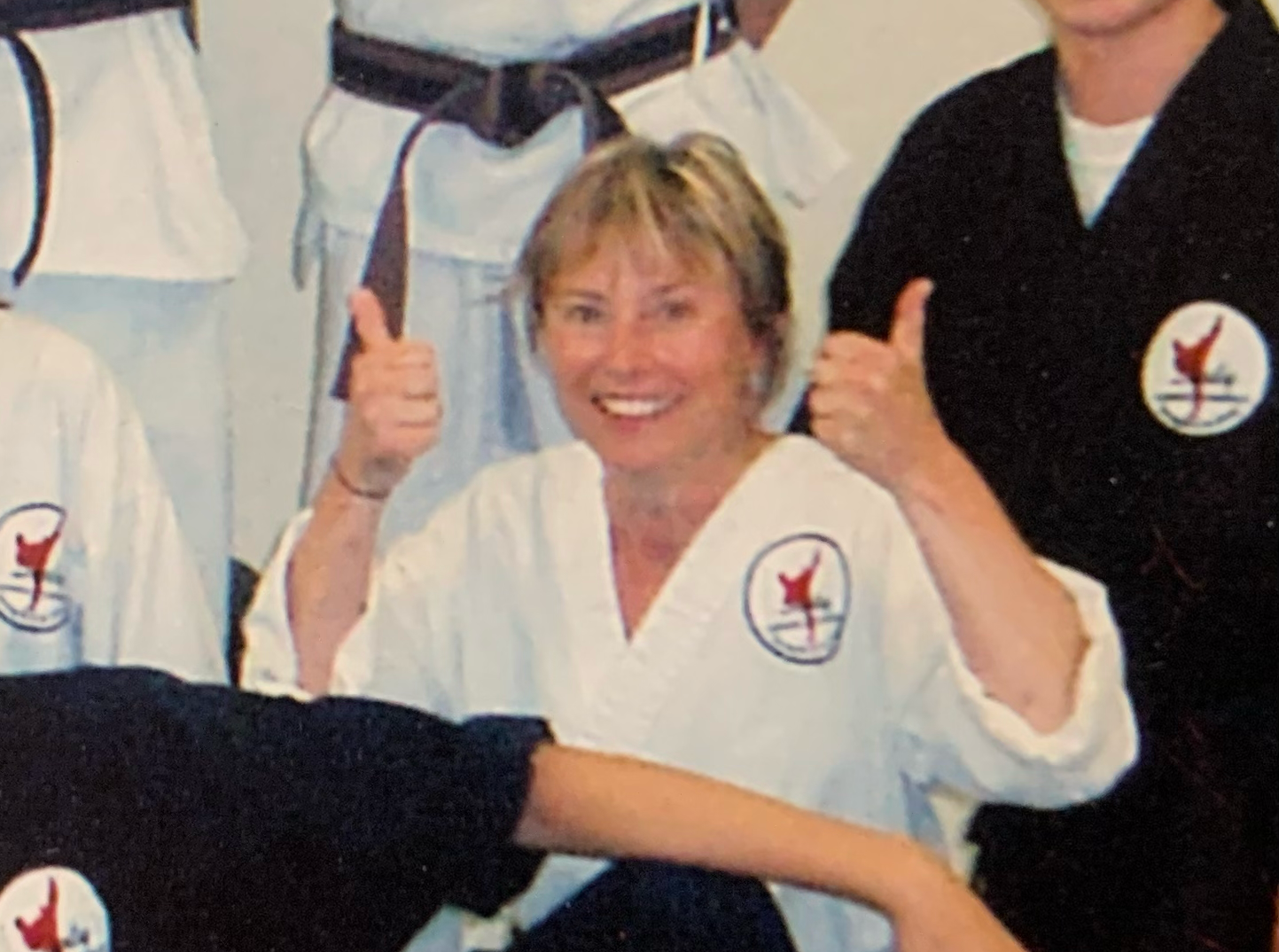
Today is my mom’s birthday. As a subscriber to this newsletter you probably know: she is dead. I started Test Obituary while exploring distribution options for her death announcement.
In addition to being a great mother, Trudy Counter is a character in my books. That’s a side effect of being related to a personal essayist. This relationship puts me in a strange position when it comes to grief. As I embark on writing another book, I need to deal with the fact that cancer didn't just kill my mom, it claimed one of my key players. And yet, because she's been narrativized, parts of her—the amazing parts that I wanted to share with the world—have been captured and preserved in language. Shards of her soul are frozen in ink and paper.
Honouring that transcendence through story, I would like to share the essay “How High Can You Kick?” from my book How to Restore a Timeline: On Violence and Memory. This piece is not about my mom, but I like to think it shows the role she played in my life: curious and enthusiastic, positive and adventurous, omnipresent. She is in this essay, and I hope you enjoy it.
Happy birthday, Mom.
How High Can You Kick?
“Stand up,” said the Man in the Blue Gi. And we did.
Mom and I stood in the dimly lit office. The room’s only window looked out onto the padded area where a young man counted loudly in Japanese, each number prompting his dozen students to punch the air in front of them. Blinds obscured the view, but we still heard the punctuated hissing of the students breathing in unison.
“Trudy,” said the Man in the Blue Gi. “How high do you think you can kick?”
“Oh,” she said, pursing her lips and shaking her head. “I don’t know.”
“Just guess. Or even better: kick as high as you can.”
She swung her leg like a pendulum, her toe peaking just above her waist.
The Man in the Blue Gi held his hand out, palm down, about a foot higher than Mom’s first attempt. “Now kick my hand.”
“That’s too high.”
“You can do it. Just kick my hand.”
She shook her head. She took a breath. She swung her leg. She touched the hand with her foot.
“Great job,” he said, beaming but unsurprised. He turned to me and repeated the process. Sure enough, when I needed to, I could kick higher.
“Karate training is going to be about what you just did,” he said. “Me and the other instructors, your fellow students, we will ask you to do things you think are beyond your limits. They aren’t. Everyone here helps everyone else do what they used to think was impossible.”
I was thirteen years old. The demonstration struck me as simple and effective. And it sunk in. Years later, when I wore my own blue gi and taught my own new students, I mimicked the kicking demo because it really did encapsulate the core of martial arts. An intangible quality, deeper than faith and community—one I can only really explain with the help of anime.
My interest in martial arts began as a fantasy, and that fantasy is titled Dragon Ball Z. Based on Akira Toriyama’s Dragon Ball manga, DBZ is a television anime that ran from 1989 through 1996, chronicling the adventures of the legendary warrior Goku, an alien who was sent to Earth as a child to destroy all civilization and make way for intergalactic land brokers. A bonk on the head erased his villainous mission from his mind, and a succession of martial arts masters turned the tables on fate, transforming him from an invading destroyer into our planet’s great defender. Now, he balances saving the world from evil forces with his duties as a new father.
While Goku’s alien heritage grants him a natural proclivity for fitness and combat, his special abilities are all earned through dedicated martial arts training. Goku does pushups and stomach crunches, practises hand movements and stances, and he meditates. His perseverance through toil and his desire for self-improvement are all it takes for him to eventually punch through mountains, move faster than the eye can see, fly through the air, and focus his ki into weaponized energy projectiles that he shoots from his hands.
Goku is not the only character in Dragon Ball Z with these abilities, which can be learned by anyone who fully dedicates themselves to unlocking their inner potential through training, as long as they have the right teacher. Goku’s human friends can fly and shoot energy beams, and so can his half-human children, Gohan and Goten. The result of this accessible superpower mythology is a rare type of fantasy that challenges the audience to try being great themselves. Goku and his friends aren’t plucked from orphanhood to attend a school for wizards, nor are they made to struggle with a mutant x-factor that can be harnessed into a unique miracle ability. They simply see their personal limits and know they can surpass them. They want to kick even higher.
Enchanted by Dragon Ball Z’s fantasy of martial arts magic, I obsessed over arcane violence and found karate. Being strong or fast or big is not enough to make someone a good fighter. Intellect and spirit also enhance a martial artist’s power. In DBZ, massive musclemen are regularly presented as cruel dullards, and even the most powerful brutes are brought to beg before the relatively tiny likes of our more powerful heroes. Power is a product of a healthy body and mind, one that can withstand the overwhelming arcane energy unlocked through special learned martial arts techniques.
The most iconic of these special moves is the legendary Kamehameha Wave, taught to Goku and his best friend Krillin by the island hermit Roshi, master of the Turtle School. The technique requires a martial artist to focus their vital energy into a ball, gather it between their hands near their hip, and hurl it forward, all while chanting, “ka … me … ha … me … ha!” The kamehameha can only be learned through tutelage and dedication, meaning anyone who can use it has participated in the community required for learning, and has exemplified the indomitable spirit required for self-improvement. The kamehameha is a teachable technique, and it trumps all others because the most powerful forms of arcane violence belong to the virtuous.
When I was thirteen, I knew the kamehameha wasn’t real. But I wanted to find the closest equivalent. So I started training.
Dragon Ball Z is an ascension narrative. It doesn’t have arcs. It’s all incline. A powerful threat wreaks havoc and threatens the existence of life in the galaxy; our heroes train to get stronger and master new special techniques, they confront and defeat the evildoer, and then train for the next threat, who is inevitably more powerful and dangerous. Along the way, our heroes grow stronger as a community, welcoming former rivals to their side— the demon king Piccolo, the three-eyed monk Tien, and the proud alien prince Vegeta— and growing their families. Everyone within Goku’s orbit joins him on an upward trajectory with no apparent end, always doing their best to get better.
When I was a white belt, it was the allure of arcane violence that motivated me. Before joining karate I wanted to take tai chi. Catholic school’s mythology of saints who could perform elemental miracles caused me to fixate on learning how to do the pious magic ascribed to the likes of Saint Aidan of Lindsfarne or Joan of Arc. (Which of course sounds delusional, but consider that I was taught that holy magic existed by teachers and priests in the same classrooms where I learned about math, biology, and chemistry.) My friend Daniel, who taught himself Bruce Lee’s Jeet Kune Do from a book, showed me his bootlegged copy of the 1993 action comedy Tai Chi Master, starring Jet Li and Michelle Yeoh. The film had the quality of the Catholic saint myths I was researching for my confirmation sacrament. Jet Li played the historical founder of tai chi, Junbao, who in the film’s climax learns to harness the wind into a kamehamehaesque projectile.
Yes, I thought. This man was real. This story is real. Just like the saints. I can become like them. I can learn magic.
The tai chi school wouldn’t allow a power-hungry thirteen-year-old to join their meditative practice, so Mom persuaded me to try karate. We enrolled in the trial program together, and the Man in the Blue Gi convinced her to train with me. Together we attended adult classes on weeknights and reviewed our katas and self-defence techniques at home. We did push-ups and stomach crunches, and learned the basic punches, kicks, and blocks, each of which had its own intricate set of movements.
When I was a yellow belt, I signed up for my first tournament. Dad dropped me off in the dojo parking lot where I met Senpai Drew, a young instructor who invited me to carpool with him and two other black belts in his red Toyota Supra he sometimes raced on weekends. I was too novice to fight, so I performed my kata, Pinan Nidan, in a high school gymnasium for a panel of judges. I came third last, or eighteenth place, whichever sounds less humiliating. The ribbon I picked up from the trophy table called me a “finalist.” It was my first public defeat.
When I was an orange belt, I started sparring. Mom bought us each a set of dark-blue protective gear— soft helmets, light gloves, foot pads, mouthguards— and on Thursday nights we suited up and fought our classmates. As a teenager, it is rare to fight your own mother with uppercuts and roundhouse kicks. I know she hated the experience, but endured it as part of the practice. I remember she had a practical attitude toward the overwhelming aspects of our training.
“If I ever need to use it in real life,” she said, “I can’t expect some bad guy to stop and start over so I can get him in an arm lock.”
Sparring tests your grit. Can you keep a cool head and apply complex arcane techniques in the heat of kumite? The adrenalin of fighting in a safe and controlled environment is often enough to turn an orange belt into a punching bag. Week after week, bruising our shins and sometimes bloodying our noses or lips, we accustomed ourselves to the slow-motion high of mock combat.
When I was a green belt, I became obsessed. I could look back and see how far I’d come, but I could also look forward and see where I was heading. The belt after green in my school was called green-stripe—it was a green belt bisected all the way through with a thin black line. I focused on its colours as I trained in front of the dojo mirrors, as if the belt were revealing my goal. Black belt excellence was what Shihan, our school’s founding master, called it. When I was green-stripe, I was allowed to start weapons training.
When I was a purple belt, I needed a job, so I applied to be an instructor. And when I was a blue belt, the Man in the Blue Gi became my co-worker. Shihan was my boss. I made my first work friends, Christy and Becca— black belt sisters who went to the public high school downtown. And crucially, I was given a key to the dojo. That meant on Saturdays when Christy, Becca, and I were charged with running the full set of weekend classes, I could show up extra early to be alone in the sacred space.
Martial arts is about community. But it’s also about your relationship with yourself. It’s about understanding your whole being—body, mind, and spirit. While community can support, drive, push, and inspire you to new echelons of prowess, I found moments of solitary training essential for exploring the connections between who I was and who I wanted to be. The dojo’s mirrors helped me to see my stances, strikes, kicks, and blocks. They showed me where the lines needed straightening, where my feet needed adjusting, where my shoulders needed squaring. They also showed me an image of myself— my own student. In those moments of quiet, I felt whole.
When I was a brown belt, I feared I was running out of time. As a teacher, I had intimate knowledge of our curriculum’s pacing. I was sixteen, it was winter, and I needed to graduate to the final pre-black belt, brown-stripe, by the summer. If I missed that checkpoint, I would not qualify for the sixteen-week black belt grading program that culminated in November. The fall after that I intended to be in Toronto, attending university. This was my only chance. I needed to accelerate my ascension.
“Shihan,” I said after tasking a class of green belts with a set of twenty-five push-ups, “I need to go faster.”
He stood in the doorway between the dojo mats and the front office. Through the windows behind him, I could see dusk gathering in the parking lot. He looked at me with his piercing eye contact and infectious smile. “Let’s do it.”
Despite what you might infer from Dragon Ball Z, there are limits to what the human body can do. But those limits can be surpassed by technology. For the martial artist who seeks unity of mind, body, and spirit through the pursuit of arcane violence, the technology of warfare presents an existential quandary: why learn to fight with your empty hands when it’s so much easier to hold a gun?
In his memoir Raw: My Journey into the Wu-Tang, New York rapper U-God dedicates a chapter to the relationship between the arcane and technological sides of violence. When he was growing up in the Staten Island projects in the 1970s, fighting with fists was more common than shootings. U-God describes the importance of the hybrid martial arts manual The 52 Hand Blocks, and he bemoans the decline of non-mortal combat on two grounds. First, that a street fight can breed respect between enemies and rarely results in deathly injury. Second, guns have nothing to do with your character. Anyone can use a gun, says U-God. A blindfolded two-year-old can use a gun.
Technology offers a shortcut to the ends of the arcane. An entire lifetime of training can produce a martial artist capable of physical feats that seem superhuman. I have seen masters jump so high and with such ease that it seems as though they’re flying as they spin into a hook kick and smash a concrete block to dust with one touch of their heel. It looks like magic. But the value of such control and strength is challenged, if not outright nullified, by an assailant with a firearm.
It was Halloween when the Man in the Blue Gi taught me and Mom about guns. Martial arts schools are made up of families, so trick-or-treating takes precedence over training. Only one other student was there, a green belt named Valerie, making four of us if you included our teacher.
“Can anyone tell me”—he pulled a wooden prop pistol from the folds of his blue top—“what to do when a person threatens you with a gun?”
We each proposed the self-defence moves we knew that might disarm a gunman. Throws, wrist locks, takedowns that control the arm holding the weapon.
“Those are all good, but the real answer is: you run.”
A gunfight is not a fight. It’s a deadly race against a trigger finger.
“You can’t dodge a bullet,” said our sensei. “Especially at close range. But most people who would use a gun to mug you are not particularly great shots, so if you run and rapidly change direction, chances are you will save yourself. If you’re cornered, give the mugger what he wants. Your wallet, your jewellery. None of it matters in comparison to your life. And if he intends to do you harm, and if you can’t run, here is what you can do.”
The gun defences were quick and brutal. The aim was to disarm and disable. Break bones, toss the gun far. Even using a prop, I remember feeling a knot in my diaphragm every time I passed in front of the barrel, each infraction representing a brush with hypothetical death. I’d never seen a real gun before, but the scenario we laid out was high enough stakes that I learned to hate them. The escalation of brutality called for wilder techniques. We were allowed to bite. We were encouraged to gouge. If we ended an encounter with the gun in our possession we were instructed to shoot the attacker or throw the gun as far as we could.
“If you threaten him back, you can’t risk him calling your bluff.”
In the face of technological violence, we are humiliated. The first time Goku is truly outmatched is in the Android Saga of Dragon Ball Z, when he and the other protectors of Earth are confronted by the perfect artificial lifeform: Cell. A biological machine created in a lab, Cell never trained a day in his abominable life. All of his power is stolen from the human victims he absorbs for energy. He is stronger. He is faster. And if he gathers his hijacked ki into a ball near his hip, he can throw it forward in a beam. Technology stole the kamehameha.
Cell embodies an existential threat to Goku and friends. Like a gun to the martial artist, he represents the futility of human perseverance in the face of technology. It’s the automation. It’s the convenience. It’s the inhuman nature of a shortcut to perfection. That’s why Earth’s victory against Cell is a moral one, steeped in metaphor.
When Cell is initially on the ropes, he initiates a self-destruct function powerful enough to obliterate the planet. As a machine striving for perfection, annihilation of all life is a technical achievement of his purpose. Goku steals the exploding android away to another planet, which is promptly destroyed along with our hero. But that’s not the end of Cell. The monster re-forms on Earth, even more powerful than before. Only this time, we don’t have Goku to protect us.
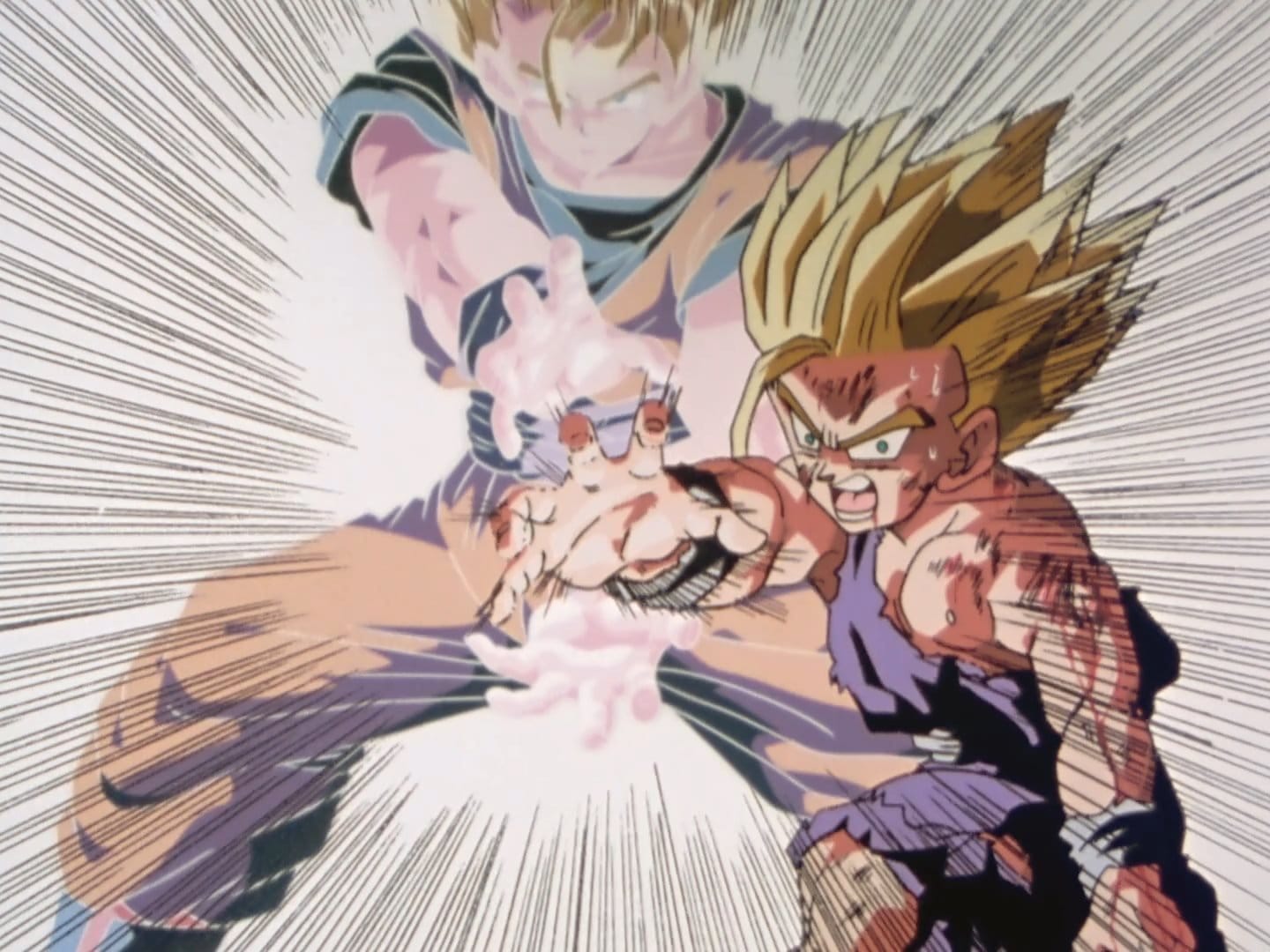
Gohan, Goku’s son, is the only warrior strong enough to even try to fight Cell. And he does poorly. The machine is unstoppable, and mortals have their limits. Gohan’s broken arm dangles at his side, useless. His friends—the best mortal warriors in the universe—watch from nearby cliffs, paralyzed with the knowledge that they’re powerless in the face of Cell’s technological superiority. And it is here, staring down the smug face of death, that Gohan exemplifies the true virtue of the martial artist. A gun can’t fire a bullet from an empty chamber. But faced with a similar limit, the martial artist pushes forward where technology grinds to a halt. With one good arm, Gohan gathers his ki near his hip, chants the syllables. Pushed well beyond all boundaries of expectation, he remembers the example of his father and he fires a final kamehameha.
How fast can you run? In my memory the whole journey started accelerating as soon as Shihan removed my brown belt and replaced it with a brown-stripe.
“Well done, Petey,” he said. My work colleagues had taken to calling me Sempai Petey in front of my kids’ classes. A term of endearment and, partially, an acknowledgement that I was the only staff member without a black belt. It was June when I earned that last colour belt. My black belt trials would begin in August.
They called us the black belt candidates. Jennifer, Katja, and I were graduating to our first degree, Nate and Travis to their second degrees, and Julie was striving for her third degree. The first thing we had to do was run. Over the span of sixteen weeks we had to jog a five-kilometre course forty times, recording speed improvements on a spreadsheet in a communal binder as we progressed. That broke down to roughly three runs per week, with two extra heats to be fit in at our own discretion.
The test was simple and elegant: can you accept the martial artist’s lifestyle of consistent challenge? The forty runs, if saved to the last conceivable moment, would be a trial of destruction rather than a gauntlet of preparation. Your speed would decline from one run to the next, your body would pound itself into the sidewalk, your test would be over before it started—the point of running, after all, was to ready us candidates for a gruelling two-day grading that was legendary in its difficulty. Running was the preliminary test, but it was also the training for the main event. For a hope at ascension, you had to start on week one. So that’s what we did.
Stopwatch in hand, legs stretched, and shoes tied tight, I loaded a CD into my brother’s anti-skip Panasonic discman—the Offspring’s Smash, the Mars Volta’s Frances the Mute, Linkin Park’s Meteora, the Kill Bill soundtracks, or a mix burned on my family computer of anything with a persistent beat and the kind of vibe that could push a seventeen-year-old boy through walls of exhaustion. I hit play and started the timer simultaneously.
Shihan traced the course himself, a five-kilometre tangle of sidewalk. Starting across from the Tim Hortons near the dojo, I ran a straight path on level ground through suburban strip mall sprawl before hanging a left into a pocket subdivision of two-storey houses with old-growth trees shading their front lawns. The sidewalk track sagged into a crescent, which spat me out onto a busy road across from a brown brick shopping centre. From there I turned right and ran up a steep incline, where the sidewalk bordered small houses with verandas. At the top of the hill, I made another right, which brought me onto the straightaway back to the dojo, but when I hit the entrance to the pocket neighbourhood, I turned into it again, ran the crescent, back up the hill of front porches, and entered the true home stretch.
The season changed and the course made its mark on my body, which—aided by my continued work and in-class training—thinned down to its efficient basics. I began to see running as a modular test. I would hit a limit, my body would scream to stop, and I would invent a checkpoint. This is how far I think I can run. And once I was there, I would glance at the stopwatch, skip to a faster song, and pick another checkpoint. The process shifted my mindset. The leaves changed colours, the first dusting of snow appeared, and I stopped seeing each run as an individual unit. I was participating in a forever race against myself, and I measured my victories by my ability to ignore whatever limitations and doubts floated in front of me. I was running too fast to see them. I left them broken like rubble on the sidewalk. I was transforming. And eventually the confidence I developed would be the subject of my final test.
If you collect the seven titular Dragon Balls, which are scattered all across the planet, the dragon Shenron will appear and grant you any wish you desire. A hallmark of the villains in Dragon Ball Z is that they wish for supreme power: eternal life, unsurpassable strength, a shortcut to the end. Our heroes don’t want that. They use the wishing orbs to reverse the tragedies caused by the power-hungry. They turn death back into life and repair communities. They protect their family. They understand there is no value to unearned power.
I was sworn to secrecy about the actual events of my black belt grading. What I can say is that it was spread over two days. First, we were in the dojo. We were isolated from each other. We were pushed past our limits. At one point, during a delirious sparring match with my co-worker Skyler, I caught a roundhouse kick in my mouth. Blood spurted onto the mats, my nerves numb from exhaustion and adrenalin. Mom, who was invited to watch, was furious. I iced it, put a pocket of gauze in my lip, and continued. The next morning, the six of us candidates met at Shihan’s ranch. The pale-blue sky was airbrushed with white clouds, and the November sun lit the scene at such an angle as to freeze the forests we ran through in a state of perpetual sunrise. This time we could fight as a team.
When he launched his final kamehameha at Cell, Gohan was acting alone—a broken teen releasing all of his violent energy in a bid for life. It wasn’t enough. The evil android’s own blast was threatening to consume the boy in annihilating light. Gohan’s friends, insects compared to the powers at play, joined the fight. Launching attack after ineffective attack in a fireworks show of pure moral support, they demonstrated exactly what the martial artist strives for: perseverance in the face of the impossible.
As I ran, as I leaped, as I hit wall after wall of exhaustion, fully fledged black belt students, each with their own memories of gradings past, emerged from the fields and out of the trees. They ran beside us, they cheered us on. I found my strength again and again, dragging my body forward even when my limbs went limp. Each word of encouragement strengthened my resolve, boosted my spirit. I was flailing. I was ascending. I was Gohan obliterating himself to achieve something unimaginable.
The scent of smoke in the air signalled the end. My fellow candidates and I sat in a circle around a campfire deep in the woods. Shihan was there, and he met each of our eyes with quiet pride. The flames were welcoming, but they stung my skin too. After a certain amount of adrenalin and pain, the body is reluctant to receive even the primal comfort of a bonfire on a cold morning.
“What you did today was the beginning of something special,” Shihan said. “Some day, you will need to surpass your limits. It might not be for a very long time. But you will remember this day, and you will remember what you did with one another, and you will find the strength you know you have. You will rise to the occasion.”
The belt was heavier than the coloured ones I was used to. Thicker. More durable. I worked at the dojo with it tied around my waist and it weighed on my hips, grounding me and strengthening my pride. Shihan gave me access to his vhs library of katas and weapons techniques, which is how I taught myself to use the three-pronged sai. I kept training. I kept teaching. But I knew my time was limited and I feared what that meant for my accomplishment. My black belt was probationary.
In order to disincentivize black belt tourism—in which bad faith students participate in karate, achieve the internationally recognized symbol of excellence, and move on to their next hobby—Shihan mandated a full year of probation. It was called shodan-ho. For twelve months, newly christened black belts had to maintain their regular training and volunteering, after which they would be granted a certificate and official first-degree black belt status.
With three months remaining on my trial period, I moved to Toronto for theatre school, suspending my probation and entering into a dojo-less limbo. Shihan burned me a dvd of videos in which he performed kata and self-defences. I trained on my own in my building’s fitness centre. I maintained, but I didn’t move forward. And when November came and I inevitably had to stay in Toronto for my exams and student performances, my window for official black belt status closed. The next summer I returned to the dojo and was allowed to train in the black belt class without question. Mom was still attending classes, preparing for her own candidacy the next year. No one mentioned my lack of official status, and I hoped my show of dedication as a returning student would suffice.
In the fall I went back to Toronto, and that winter I would be tested again.
I stood on the wooden pier, overdressed. Blue jeans, black leather belt, and a green hoodie over a T-shirt I got from the 2004 Canadian Open Martial Arts Challenge. The gunman stood between Dad and me, poking the barrel of his blue pistol at each of us. The ocean roared at our backs. The Man in the Blue Gi flashed in my mind. Whatever you have isn’t worth dying over. But we were cornered and we left all our money on the ship.
Dad kicked at the man. Once. Twice. And then he fell. My eardrums screeched from the gunpowder pop. I ran to my father as the shooter fled.
“He bit me.”
“You got shot?”
“He bit me.”
“Did he shoot you?”
“Yes.”
I helped Dad to his feet. Slung his arm over my shoulder, and we stumbled on our way to safety. I dropped him. Three times. My body screamed. I screamed. Dad’s eyes fluttered shut and I was weak. My mind flickered through a million useless sounds and images, searching via free association for any ember of hidden motivation that could get me through to the other side. Scenes from TV shows, memories of previous vacations, Nick and Mom’s itinerary, the map to the cruise ship we rode in on, the prayers I memorized in school. The tournament where I got my shirt, how Dad bought it for me after winning a gold medal for the first time in my life. There was no one left to fight, but I frantically grasped at memories of my training. The gun defences. The smell of sweat. The familiar burning of overworn muscles. I thought of a hand held out in midair, challenging me to kick higher.
I pushed myself from the ground and began to drag Dad toward the ship. Today, when I remember that moment of finding strength, a wire gets crossed and I swear I can smell smoke from a bonfire.
Like what you read? There’s more where that came from in How to Restore a Timeline: On Violence and Memory, which is available wherever you buy books.
PETER COUNTER is a culture critic writing about television, video games, film, music, and technology. He is the author of Be Scared of Everything: Horror Essays and How to Restore a Timeline: On Violence and Memory.
TEST OBITUARY is a journal where he explores unfinished ideas about culture and shares it with you. If you would like to contact Peter about anything you can follow him on Bluesky or email: contemplatethevoid@gmail.com